Looking for Car AC Repair Near Me? We're in Al Quoz, Dubai
Our workshop is at 1 - D65 Al Manara St - East, Al Quoz — just off Sheikh Zayed Road and minutes from Business Bay, Al Barsha and Jumeirah. Car AC repair is From AED 150, the inspection is free, and walk-ins are welcome every day from 9 AM to 9 PM. Most AC jobs are finished the same day.


Stay Cool on Dubai Roads with Expert Car AC Repair
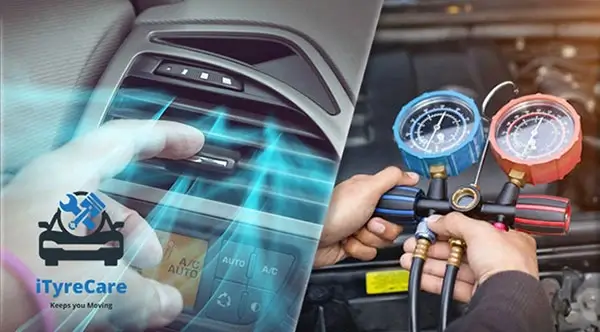
The weather in the UAE is unusually hot, with temperatures reaching 50°C in summer. A fully running air conditioning system in your vehicle is not a luxury, it is an essential. Regular car AC maintenance, such as air filter, freon, air duct cleaning, etc, improves the cooling efficiency of your car. If you spend some of your valuable time on regular car AC servicing, you can keep away from crucial repairs.
Is your car's fan not providing the cool air it needs on a hot day? If you are facing such a situation, then contact our service center without delay! At iTyreCare, we understand how busy you are, which is why we offer fast, hassle-free car AC repair in Dubai with uncompromising quality. We have a team of skilled professionals with the latest tools along with years of experience in repairing the entire cooling system. Our specialty is to provide accurate diagnosis of air conditioner issues and effective service.
Beat Dubai's brutal heat today. iTyreCare delivers expert car AC repair in Al Quoz with same-day service you can count on. Call +971 4 227 9700 or WhatsApp us now — we're open 7 days a week, including Sundays. Cool comfort ride is just one call away.
What's Included in Our Car AC Repair Service
Blower Motor
A blower motor provides airflow to the vents. If a malfunction occurs, you may notice unusual and distinct sounds in the cabin, as well as a drop in air pressure. If you are facing such a situation then contact us for blower motor repair before further damage, and we will solve the problem effectively. Get your car AC blower motor checked without waiting.
Evaporator
The car's AC evaporator, a crucial component located within the dashboard, functions as a miniature radiator. Its primary role is to chill the air and circulate it throughout the car cabin. The evaporator coil is made of metal which over time due to constant humidity will rust and cause gas leakage. Replacing the evaporator requires special skills. At iTyreCare we have extensive experience in repairing all types of car AC in uae.
Gas Refilling
Low refrigerant is the most common reason a car AC blows warm air. We measure system pressure, top up or fully recharge R-134a or R-1234yf gas, then pressure-test afterwards to confirm the system is holding and not leaking. Skipping the leak test is why a re-gas done cheaply elsewhere often stops cooling again within weeks. Car AC gas refilling is From AED 150 at our Al Quoz workshop.
Compressor
Since a compressor acts as the heart of a cooling system, possible causes of failure can be low pressure, grinding noise, and carbon build-up. These are the reasons why a car AC compressor needs to be replaced. If your car cooling system is not working properly, you can get a free checkup from our experts who will determine if the faulty AC compressor can be repaired or replaced. We provide the best car AC repair service in Dubai.
A/C Filter
A car air filter is a vehicle component that over time produces odours and germs that can affect your health. Our experts suggest that the air filter should be changed every 15,000 km or once a year. This is very helpful in keeping the environment of your car pleasant and maintaining a functioning air conditioning system. We have a wide range of all vehicle air filters available at competitive prices to suit your needs.
Condenser
The condenser sits behind your front grille. It turns the refrigerant from a hot gas into a cold liquid. Damaged seals and leaking pipes are the most common condenser issues. Timely car AC maintenance keeps your whole cooling system working properly.
Keep Your Car AC Running Smoothly!
Simple habits that protect your AC, save you money, and keep cool air flowing through the UAE summer.
Schedule regular AC inspections
Regularly inspecting your AC system by a professional mechanic can help identify potential repairs before they become major issues.
Keep your car's AC serviced
Regularly service the condenser and evaporator to prevent dirt and debris from building up and reducing efficiency.
Use your AC regularly
Regular use of your car's AC system can help prevent car AC repair issues caused by lack of use.
Keep your refrigerant levels topped up
Regularly checking your car's refrigerant levels and topping them up as needed can help prevent issues caused by low refrigerant levels.
Four numbers that prove we're different.
Every step of our car AC repair process is measured, transparent, and built to save you time and money.
To book your repair
One call, one tap, one WhatsApp — done. We collect your car from anywhere in Dubai, free.
To diagnose the fault
Factory scan tools, pressure tests, written quote — all free. You only pay if you approve the repair.
In every repair
Genuine refrigerants and manufacturer-spec components. No knock-offs, no compromises — backed in writing.
Cold air, same day
Most repairs are back at your door by sundown. Pay with cash, card, Tabby, or Tamara — your choice.
Or WhatsApp your location and we'll send a free quote in minutes.












Free AC Inspection — Know Before You Spend
Not sure what is wrong with your AC? Bring your car in — or let us collect it — and we inspect the entire system at no cost. No obligation. No pressure.
Our free AC inspection covers:
- Refrigerant pressure and level
- Compressor operation and clutch engagement
- Condenser and evaporator condition
- Cabin air filter status
- Electrical connections, fuses, and sensors
- Vent temperature output test
After the inspection, we give you a written report explaining exactly what we found and what it costs to fix. You decide whether to proceed. We never start work without your approval.
Book your free AC inspection — +971 4 227 9700
Why Choose Us?

When it comes to car AC repair in Dubai, iTyreCare sets the standard. Our expert technicians handle even the most complex air conditioning systems with precision, keeping your car cool through every season — and at prices around 40% lower than the dealership, without ever cutting corners on quality. We service luxury brands like Mercedes, BMW, Audi, and Porsche, trusted everyday cars like Toyota, Honda, and Nissan, electric vehicles like Tesla, and a wide range of others including Ford, Lexus, Chevrolet, Hyundai, Kia, Jeep, Land Rover, Mitsubishi, Volkswagen, and Infiniti.
Backed by a 4.7-star Google rating and hundreds of satisfied customers, we deliver fast, reliable, and professional service every single time. Find us in the heart of Al Quoz, just off Sheikh Zayed Road at Exit 43 — one of Dubai's most convenient locations. Call +971 4 227 9700 today and experience the quickest, most trusted car AC repair service in Dubai. Stay cool, drive comfortably, and leave the rest to us.
What Dubai Car Owners Say
"Service is excellent, they did a full check with my car AC and explained the issue & what need to be fixed and quoted me with good price. Definitely will visit again..."
"Great experience. AC in my 2011 Chevrolet Camaro was not working. Another garage took it and told me nothing was wrong. iTyreCare picked up my car at 9.30 (on time), diagnosed the problem quickly, confirmed a reasonable price and fixed it within a few hours. My car was back at my house by 4pm completely fixed same day. Great work and thank you."
"AC in car regassed in less than one hour from my first message, at my front door, on a Saturday evening. Price 20-30% lower than other companies I contacted. Definitely recommended!"
Our Car AC Services in Al Quoz, Dubai
Not sure which AC service you need? Start with a free inspection and we will tell you. Each service below has its own page with prices and full detail.
Car AC Gas Refilling
R-134a and R-1234yf refrigerant recharge with a pressure test afterwards. From AED 150.
AC Compressor Replacement
Diagnosis and replacement of a failed compressor or clutch, with system flush where needed.
AC Condenser Replacement
For condensers blocked or damaged by Dubai sand and road debris, causing poor cooling.
AC Disinfectant & Sanitisation
Clears the musty smell caused by bacteria and mould on the evaporator core.
AC Not Cooling? Diagnose It
A step-by-step guide to checking your own AC before you pay anyone to look at it.
Car AC Repair Cost Guide
What each AC repair costs in Dubai, warning signs, and how to choose a workshop.
How Car AC Works
The compressor, condenser, evaporator and expansion valve explained in plain English.
Full Car Service
Combine your AC repair with a minor or major service in the same visit. From AED 249.
Frequently Asked Questions
Where can I get car AC repair near me in Dubai?
Our workshop is at 1 - D65 Al Manara St - East, Al Quoz, Dubai, just off Sheikh Zayed Road and central to most of the city. If you are searching for car AC repair near me, we are within a short drive of Business Bay, Al Barsha, Jumeirah, Umm Suqeim, Al Wasl, Downtown Dubai and Dubai Marina, and customers also come to us from Motor City, TECOM, Nad Al Sheba and Jumeirah Village Circle. We are open daily from 9 AM to 9 PM and walk-ins are welcome, so you do not need an appointment. Call +971 4 227 9700 or message us on WhatsApp and we will confirm a bay is free before you drive over.
How much does car AC repair cost in Dubai?
Car AC repair at iTyreCare is From AED 150, and the final figure depends entirely on which component has failed. A refrigerant top-up or gas refill sits at the lower end. Replacing a cabin filter is a minor job. A condenser, evaporator or compressor replacement costs considerably more because of the part price and the labour involved in evacuating and recharging the system. This is exactly why we run the diagnostic first and give you a written quote before any work starts: you approve the price before we touch the car. The AC inspection itself is free, so a diagnosis costs you nothing.
Is the AC inspection really free?
Yes. We connect gauges to the high and low side of your system, read the pressures, check for leaks with UV dye or an electronic leak detector, test the blower and cabin filter, and measure the vent temperature. You then get a written report explaining what we found and what it will cost to fix. There is no charge for this and no obligation to proceed. We do it this way because AC faults are frequently misdiagnosed, and customers are often quoted for a compressor when the actual fault is a leaking O-ring or a blocked cabin filter costing a fraction as much.
Why is my car AC blowing warm air?
The most common cause is low refrigerant from a slow leak, since every AC system loses a little gas over time and Dubai heat accelerates it. Other frequent causes include a failed compressor or compressor clutch, a condenser blocked with sand and dust, a clogged cabin air filter restricting airflow, an electrical fault in a relay or pressure switch, or a blend door actuator stuck on the hot setting. Because several of these produce identical symptoms, guessing wastes money. Our free inspection identifies which one it actually is before you spend anything. For a full walkthrough see our car AC not cooling diagnostic guide.
How long does car AC repair take?
A gas refill with a leak test takes about 45 to 60 minutes and most customers wait for it. A cabin filter change is quicker still. A condenser replacement typically takes half a day. A compressor replacement usually takes a full day, because the system has to be evacuated, the new unit fitted, the receiver drier replaced, and the whole system vacuum-tested and recharged before we can verify cooling performance properly. We tell you the expected turnaround at the same time we give you the written quote, and a large share of AC jobs are finished the same day. If your car genuinely needs to stay overnight, we will say so up front rather than after you have left it with us.
How often should I service my car AC in Dubai?
We recommend a car AC service every 12 months or 15,000 km in Dubai. That is more frequent than manufacturers typically advise for temperate climates, and for good reason: sustained high ambient temperatures degrade refrigerant oil, harden rubber seals and O-rings, and load the compressor far harder than it would work in Europe. Airborne sand also clogs condenser fins and cabin filters much faster here. An annual service catches a slow leak while it is still an inexpensive fix, rather than after the system has run low on refrigerant long enough to starve the compressor of lubrication and destroy it.
Do you refill both R-134a and R-1234yf refrigerant?
Yes, we handle both. R-134a is used in most vehicles built before roughly 2017, while R-1234yf is standard on newer models and is significantly more expensive per kilogram. The two are not interchangeable and require separate equipment, so any workshop quoting one price for both is worth questioning. We identify which gas your vehicle uses from the under-bonnet label before quoting. Every refill includes a pressure test afterwards to confirm the system is holding, because refilling without finding the leak simply means you are back in a few weeks having paid twice. Where we find a leak, we quote the repair separately so you can decide. See our car AC gas refilling page for the full price list by vehicle.
How do I know if my AC compressor has failed?
Typical signs are warm air from the vents despite a full refrigerant charge, a loud grinding or squealing noise when the AC is switched on, a compressor clutch that fails to engage, or visible refrigerant oil leaking around the compressor body. In some cases the clutch seizes and the drive belt squeals or snaps. A failed compressor can also send metal debris through the system, which then requires flushing the lines and replacing the receiver drier and expansion valve as well, which is why the job costs what it does. Several of these symptoms overlap with much cheaper faults, so this is exactly the repair worth diagnosing properly before anyone quotes you for it. Full detail, including prices by vehicle, is on our AC compressor replacement page.
Why does my car AC smell bad when I turn it on?
A musty or sour smell almost always means bacteria and mould growing on the evaporator core inside your dashboard. Condensation forms there every time you run the AC, and in Dubai humidity that damp surface becomes an ideal breeding ground, particularly if the cabin filter has not been changed recently. The smell is not simply unpleasant, it is being blown directly into the air you and your passengers breathe, which matters more if you regularly carry children or anyone with asthma or allergies. An AC disinfectant and sanitisation treatment cleans the evaporator and the ducting behind it, and replacing the cabin filter at the same time stops the smell returning within weeks. A useful habit is switching the AC compressor off a minute before you park while leaving the fan running, which dries the evaporator and slows regrowth.
Can I keep driving with a broken car AC?
Mechanically you can, but there are two good reasons not to leave it. First, in Dubai summer conditions a cabin without working air conditioning becomes genuinely dangerous on longer drives, and demisting in winter rain also depends on the AC system. Second, the underlying fault usually worsens and gets more expensive. Running a system that is low on refrigerant starves the compressor of the oil carried in that refrigerant, and a compressor that could have been saved by an early leak repair may then need full replacement, along with flushing the lines. Getting it diagnosed early is almost always the cheaper path.
Do you repair car AC for all makes and models?
Yes. We service Japanese, Korean, American, European and Chinese vehicles, from everyday hatchbacks and family SUVs through to luxury saloons and performance cars. That covers Toyota, Nissan, Honda, Mitsubishi, Hyundai, Kia, Ford, Chevrolet, Jeep, Dodge, Mercedes-Benz, BMW, Audi, Volkswagen, Porsche, Land Rover and Lexus among many others. Our technicians use manufacturer diagnostic procedures and we fit OEM or OEM-equivalent parts rather than the cheapest option available, because AC components that fail early cost you the labour twice. Certain brands have well-known AC weak points and we see them often enough to recognise the pattern quickly, which shortens diagnosis time considerably. If your vehicle is still under warranty, tell us before we start, since some AC work may be covered by your dealer and we would rather point that out than take the job.
Do I need an appointment for car AC repair?
No appointment is necessary. We are open every day from 9 AM to 9 PM and walk-ins are welcome at our Al Quoz workshop, which is how most of our AC customers arrive, particularly during the summer months when a failed AC becomes urgent. That said, calling +971 4 227 9700 ahead is worth doing during July and August, our busiest period, so we can have a bay and a technician ready when you arrive rather than having you wait. If your car will not start or is not safe to drive, ask us about recovery and we will arrange collection.