Steering & Alignment

Why Does My Car Pull to One Side?

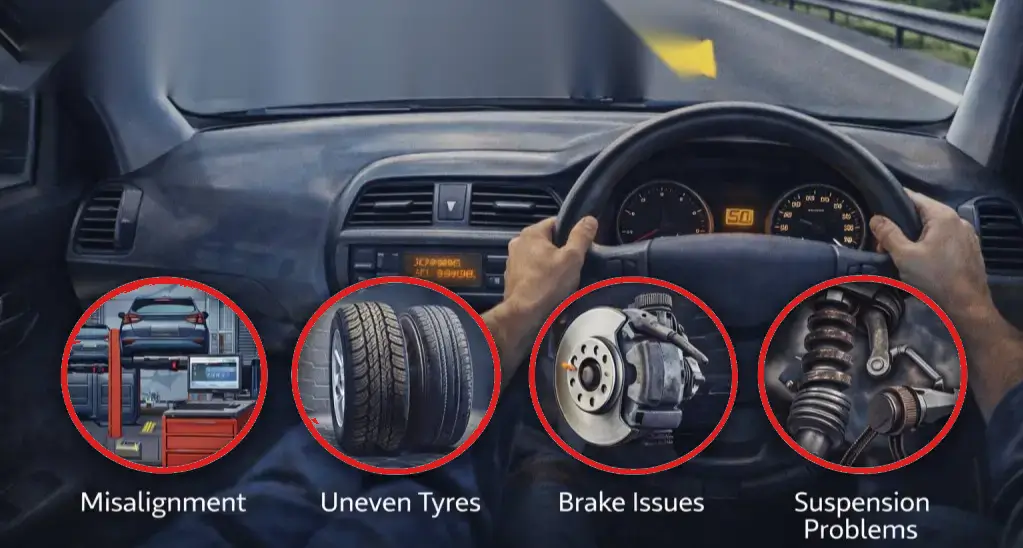
Your car should drive in a straight line without you fighting the steering wheel. If it keeps drifting left or right on its own, something is wrong — and it needs your attention.

iT
By iTyreCare Technical Team Senior Technician, iTyreCare Al Quoz
Last reviewed: April 2026
12 min read
Why does my car pull to one side - causes and fixes by iTyreCare Dubai

A car that drifts left or right without you turning the wheel has a problem. It might be minor — a tyre that needs air — or it could signal a brake fault that needs immediate attention.

The good news: you can narrow down the cause yourself in 10 minutes. The important question is whether you should keep driving while you figure it out.

This guide walks you through all 9 causes, a 5-step diagnostic test you can run at home, and honest car repair cost estimates in AED.

Is It Safe to Drive When Your Car Pulls to One Side?

Answer this question first, before you do anything else.

Gentle drift on one road only

Risk: Low

Check tyre pressures this week

Consistent pull, still controllable

Risk: Moderate

Book an inspection within 48 hours

Car pulls toward another lane without much effort

Risk: High

Drive slowly and go straight to a workshop today

Sharp pull when you brake — steering jerks to one side

Risk: Very High

Stop driving immediately — brake fault suspected

Burning smell + pull when braking

Risk: Critical

Pull over safely and do not drive further

A light drift on a specific road can be normal — roads in Dubai are built with a slight slope to drain rainwater, and this can make your car lean slightly toward the kerb. However, a consistent pull on any road, at any speed, is not normal. Get it checked.

Normal vs Abnormal — How to Tell the Difference

Not every pull is a fault. Manufacturers align cars to drift slightly to the right on purpose. If a driver falls asleep or releases the wheel, the car moves toward the shoulder instead of into oncoming traffic.

This natural right-side bias is gentle and barely noticeable. You can easily correct it with one finger on the wheel.

If your car pulls hard to one side, requires constant steering correction, or pulls differently when you brake or accelerate, that is an abnormal pull. Work through the 9 causes below to find out what is causing it.

When Exactly Does Your Car Pull? (Start Here)

The timing of the pull narrows down the cause immediately. Read the situation that matches yours and jump to the relevant section.

It pulls all the time, even on a flat straight road

Most likely cause: Wheel misalignment or uneven tyre pressure.
See: Cause 1 and Cause 2 below.

It pulls only when I press the brake pedal

Most likely cause: Stuck brake caliper, uneven brake pad wear, or a brake hydraulic fault.
See: Cause 6 below. Do not ignore this — brake faults are a safety emergency.

It pulls only when I accelerate hard

Most likely cause: Torque steer. This is common in front-wheel-drive vehicles and is caused by the engine sending more power to one wheel than the other.
See: Cause 8 below.

It pulls in the direction I just turned, then slowly straightens

Most likely cause: Memory steer. Binding strut bearings or tight ball joints cause the steering to hold the last turn angle instead of returning to centre.
See: Cause 7 below.

It started pulling after I fitted new tyres

Most likely cause: Tyre conicity (a manufacturing defect), pressure difference, or wheel alignment disturbed during fitting.
See: Cause 4 and the dedicated new-tyres section below.

It only happens on certain roads, not on others

Most likely cause: Road crown — the road surface is sloped, not your car.
See: Cause 9 below.

9 Reasons Your Car Is Pulling to One Side (With Fixes)

Cause 1 — Wheel Misalignment

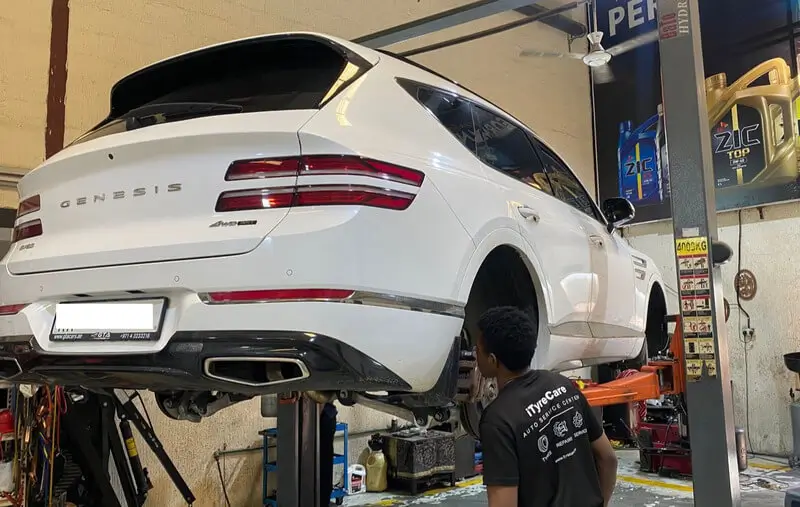
Wheel misalignment causing car to pull to one side

Wheel alignment controls three angles that determine how your tyres meet the road: camber (inward or outward tilt when viewed from the front), caster (forward or backward tilt of the steering axis from the side), and toe (whether the front edges of the wheels point inward or outward from above).

When any of these angles shift — from hitting a pothole, mounting a kerb, or simply through daily driving — the car pulls toward the side with the greater misalignment. This is the single most common cause of a car pulling to one side.

How to identify: Release the steering wheel briefly on a flat, straight road. If the car drifts consistently to one side at any speed, misalignment is the most likely cause.

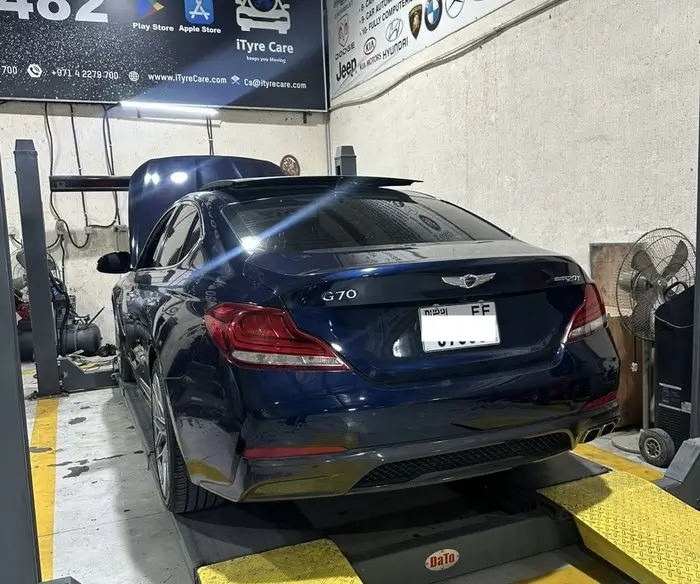
Fix: A four-wheel wheel alignment at iTyreCare takes approximately 45 minutes. The technician adjusts camber, caster, and toe to the manufacturer's specification using laser-guided equipment.

Cause 2 — Uneven Tyre Pressure

A low-pressure tyre flattens slightly, creating a larger contact patch and more rolling resistance. Your car pulls toward the low-pressure side because that wheel drags more than the other.

How to identify: Check all four tyre pressures with a gauge when the tyres are cold (before driving or after the car has been parked for at least 3 hours). Compare them to the recommended PSI on the driver's door sticker.

Fix: Inflate all tyres to the correct PSI. This is free and takes 5 minutes. If one tyre keeps losing pressure, it may have a slow puncture — bring it in for a tyre puncture repair.

Important for Dubai drivers: Tyre pressure changes with temperature. In summer, ambient heat can increase tyre pressure by 3-5 PSI. In winter mornings, pressure drops. Check every two weeks to keep all four tyres within specification.

Cause 3 — Uneven Tyre Wear

If one front tyre has significantly less tread than the other, it grips differently. The car pulls toward the tyre with more tread because it generates more lateral force. This differs from a pressure issue — the tyres may hold the correct PSI but still wear unevenly.

How to identify: Look at the front tyres side by side. If one has noticeably less tread depth, or if the wear pattern is uneven across the tyre surface (inner edge worn more than outer, or vice versa), this is likely contributing to the pull.

Fix: Replace the worn tyre, then fix the root cause of the uneven wear (usually misalignment or a suspension fault). Rotate your tyres every 10,000 km to keep wear even.

Cause 4 — Tyre Conicity (Manufacturing Defect)

Tyre conicity happens when a tyre's internal belts are not perfectly aligned during manufacturing. The tyre inflates into a slight cone shape instead of a cylinder — and a cone rolls in a curve, not a straight line. This pulls the car to one side, usually immediately after fitting new tyres.

How to identify: Swap the two front tyres from left to right (side to side only — do not move them front to back). If the pull switches to the opposite direction, the tyre has a conicity defect.

Fix: Return the defective tyre to the supplier. Most manufacturers cover conicity defects under warranty if the tyre is new and has minimal wear.

Cause 5 — Suspension Component Wear

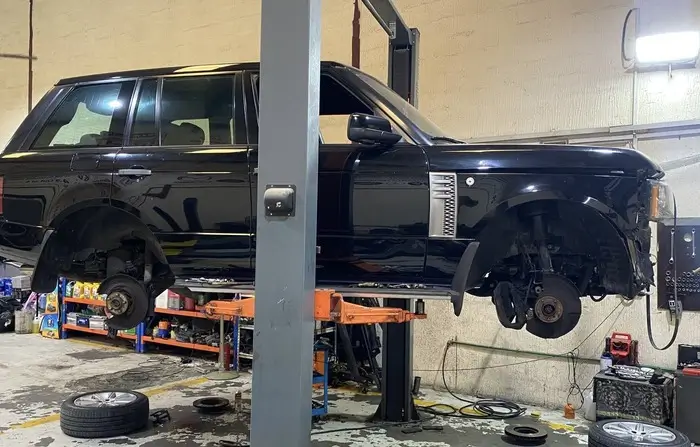
Suspension component wear causing car to pull to one side

Your suspension holds each wheel at the correct angle. When components wear out, wheel angles shift and the car starts pulling. The most common culprits are control arm bushings, ball joints, tie rod ends, and strut mounts.

Dubai's speed bumps accelerate suspension wear significantly. Vehicles driven daily over speed bumps in residential areas like JVC, Al Barsha, and Mirdif often develop suspension-related pulling earlier than expected.

How to identify: A suspension inspection on a lift is required. A technician checks for play in ball joints, torn bushings, and worn tie rods by physically testing each component.

Fix: Replace the worn component. After replacement, a wheel alignment is always required because suspension repairs change wheel angles.

Cause 6 — Brake System Fault

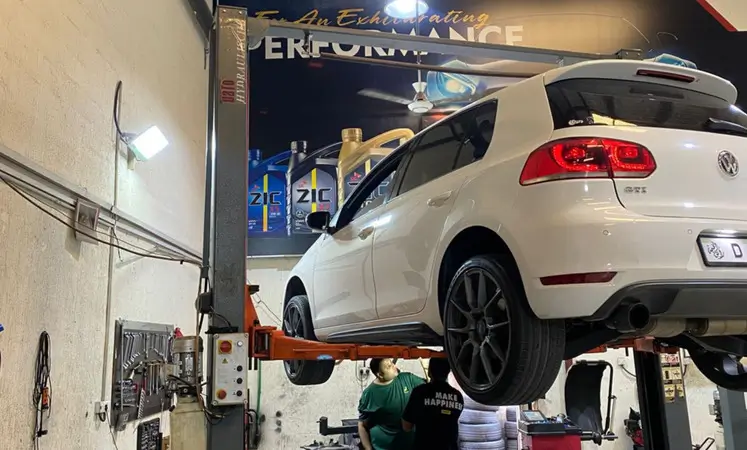
Brake system fault causing car to pull to one side

If your car pulls only when you press the brake pedal, the brake system is at fault. Unequal braking force between the left and right wheels pushes the car toward the side that brakes harder.

The three most common brake-related causes are: a stuck brake caliper (one caliper fails to release fully, dragging on one wheel), uneven brake pad wear (one side has significantly thinner pads), and a brake hydraulic imbalance (a blocked brake line or leaking caliper reduces pressure on one side).

How to identify: Brake gently from 40 km/h on a quiet, flat road. If the car pulls only during braking, the brake system is at fault. You may also notice a burning smell from one wheel after driving — this indicates a stuck caliper.

Fix: A brake inspection will identify the faulty component. Do not delay — brake faults are a safety emergency.

Cause 7 — Memory Steer

Memory steer means your car keeps pulling in the direction of your last turn. Turn right on a roundabout, and the car drifts right even after you straighten the wheel. Turn left at a junction, and it drifts left afterward.

A binding strut mount bearing or tight ball joint prevents the steering from returning to centre after a turn. The faulty component physically holds the last steering angle instead of releasing it.

How to identify: Turn right on a roundabout, then drive straight. Does the car drift right? Now turn left. Does the drift switch to the left? If the pull always mirrors the last turn direction, memory steer is the cause.

Fix: Replace the binding strut mount bearing or ball joint. This is a mechanical repair that requires a suspension inspection to pinpoint the exact component.

Cause 8 — Torque Steer (Front-Wheel-Drive Cars Only)

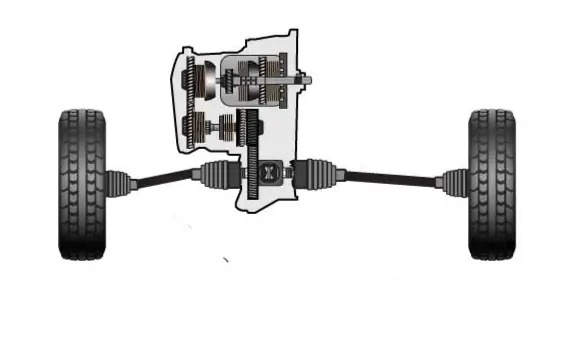
Torque steer in front-wheel-drive car causing pull to one side

Torque steer affects front-wheel-drive (FWD) vehicles only. The left and right driveshafts are often different lengths, so under hard acceleration, the engine delivers slightly more power to one front wheel — pulling the car to that side.

Mild torque steer under full throttle is normal for most FWD cars. However, severe pulling under normal acceleration — or pulling that has recently worsened — points to worn engine mounts, CV joints, or control arm bushings amplifying the effect.

How to identify: Accelerate normally from a standstill, then shift to neutral and coast. If the car pulls under power but tracks straight while coasting, torque steer is the cause.

Fix: Minor torque steer is a design characteristic — no repair needed. Severe or worsening torque steer requires a steering and drivetrain inspection to check engine mounts and CV joints.

Cause 9 — Road Crown (Not Your Car's Fault)

Road engineers build a slight slope into road surfaces to drain rainwater toward the gutters. Dubai's roads have a noticeable crown. When you drive on a crowned road, gravity pulls the car slightly downhill toward the kerb — and this feels exactly like a steering pull.

How to identify: The pull happens only on specific roads and disappears on flat roads, parking structures, or highways with different road profiles. If you drive the same road in the opposite direction, the pull switches sides.

Fix: No repair needed. Your car is fine. If it bothers you on your daily commute route, a very slight alignment adjustment can compensate — but this may cause a pull on flat surfaces.
How to Diagnose the Cause Yourself — 5-Step Test

Run this test before booking a workshop appointment. It takes 10 minutes and narrows the cause down before you speak to a technician.

How to diagnose why your car pulls to one side — 5-step test
1

Check tyre pressures cold

Before driving, check all four tyre pressures with a gauge. Inflate any low tyre to the recommended PSI shown on the driver's door sticker. Drive and test. If the pull disappears after inflating, uneven pressure was the cause.

2

Drive on a flat, straight road and release the wheel briefly

Drive at 60 km/h on a flat straight road. Release the steering wheel briefly for 2-3 seconds. Observe which direction the car drifts and how quickly. A slow drift suggests minor alignment or pressure issue. A fast pull toward one side indicates a more serious mechanical fault.

3

Swap the two front tyres left to right

Ask a tyre shop to swap only the front tyres from side to side. If the pull switches to the opposite direction, the tyre is defective (conicity). If the pull stays on the same side, the cause is alignment or mechanical.

4

Test braking on an empty road

Brake gently from 40 km/h on a quiet, flat road. If the pull appears only when braking, the brake system is at fault — not the tyres or alignment. Book a brake inspection immediately.

5

Test under acceleration (FWD cars)

Accelerate normally from a standstill, then shift to neutral and coast. If the car pulls under power but tracks straight while coasting, torque steer is the cause. Minor torque steer is normal in front-wheel-drive vehicles.

Tip: Take your test results to your technician. Telling them "the pull only happens under braking" or "it switches sides after swapping the front tyres" saves diagnostic time and often reduces the cost of the inspection.

What Happens If You Ignore a Car That Pulls to One Side?

A pulling car does not fix itself. Ignoring the problem triggers a chain of secondary faults that cost significantly more to repair later:

  • Uneven tyre wear: Misalignment or a pressure difference wears one tyre faster than the other. You replace tyres more often and spend more on rubber.
  • Higher fuel consumption: Misaligned wheels create drag that your engine must overcome. You burn more fuel on every drive.
  • Steering fatigue: Constant micro-corrections wear you out on long drives and slow your reaction time in emergencies.
  • Suspension damage: A worn bushing or ball joint you do not replace stresses adjacent components. One failed part leads to another — and a bigger repair bill.
  • Safety risk: A strong pull catches you off guard during emergency lane changes or on wet roads. A brake-related pull increases stopping distance on one side, making the car unpredictable under hard braking.

My Car Pulls to One Side After Fitting New Tyres — What Happened?

1

Tyre conicity

A manufacturing defect where the tyre's internal belts are misaligned, causing it to roll like a cone instead of a cylinder. Swap the two front tyres left to right — if the pull switches sides, the tyre is defective. Return it to the supplier under warranty.

2

Alignment not rechecked after fitting

Removing and refitting wheels can disturb alignment slightly — especially if your vehicle was already borderline. Always request a wheel alignment check after fitting new tyres.

3

Mismatched tread pattern or tyre brand

Different tyre brands or tread patterns on the same axle create uneven grip. The tyre with more grip resists rolling more, pulling the car to that side. Always fit matching tyres on the same axle.

4

Tyre pressure not set correctly after fitting

Some tyre shops inflate to a generic pressure rather than checking your vehicle's specification. Always verify all four pressures yourself after any tyre fitting.

Wheel Alignment vs Wheel Balancing — Which One Fixes Pulling?

Drivers confuse these two services constantly — but they fix completely different problems:

Wheel Alignment

Fixes: Car pulling to one side, uneven tyre wear, steering wheel off-centre.

What it does: A technician adjusts camber, caster, and toe to the manufacturer's specification so the car tracks straight.

Wheel Balancing

Fixes: Steering wheel vibration, shaking at highway speeds, uneven tyre wear patterns.

What it does: A technician attaches small weights to the wheel rim to correct weight imbalances so the tyre/wheel assembly spins evenly.

Bottom line: If your car pulls to one side, you need an alignment check — not balancing. If your steering wheel shakes at speed, you need balancing — not alignment. These are two different services that fix two different problems.

Repair Cost Estimates in Dubai (AED)

Wheel alignment (4-wheel)

AED 120 – 200

45 minutes

Tyre pressure adjustment

Free

5 minutes

Single tyre replacement (mid-range)

AED 300 – 600

30 minutes

Brake caliper inspection

AED 80 – 150

30 minutes

Brake caliper replacement (per wheel)

AED 400 – 900

1–2 hours

Strut mount bearing replacement

AED 350 – 700

1–2 hours

Ball joint replacement (per wheel)

AED 300 – 650

1–2 hours

Control arm bushing replacement

AED 250 – 500

1–2 hours

Full suspension inspection

AED 100 – 200

45 minutes

Note: These are estimated market rates in Dubai as of 2026. Final pricing depends on your vehicle make, model, and the specific parts required. Contact iTyreCare for an accurate quote before any repair.

How to Prevent Your Car from Pulling to One Side

Check tyre pressures every two weeks

Dubai's temperature swings cause tyre pressures to fluctuate. A 10-degree change shifts pressure by 1–2 PSI. Check when cold and inflate to the specification on your driver's door sticker.

Rotate your tyres every 10,000 km

Front tyres wear faster than rears, especially on front-wheel-drive vehicles. Regular rotation keeps wear even across all four tyres and prevents one-sided pulling from uneven tread depth.

Get a wheel alignment check every 12 months

Alignment drifts over time from normal driving. An annual alignment check catches small shifts before they become a noticeable pull or cause uneven tyre wear.

Inspect your suspension after kerb or pothole impacts

A hard kerb hit or deep pothole can instantly shift alignment angles or damage suspension components. If you hit something hard, get an inspection — do not wait for symptoms to appear.

Frequently Asked Questions

Can I drive safely when my car pulls to one side?

It depends on how strong the pull is. A gentle drift that you can correct easily is low risk for short distances, but you should still identify and fix the cause within a few days. A strong pull that moves the car toward another lane without much effort is dangerous — reduce your speed and go directly to a workshop.

Why does my car pull to one side only when I brake?

When a car pulls only under braking, the brake system is the cause — not the tyres or alignment. The most common reasons are a stuck brake caliper, uneven brake pad wear, or a brake fluid issue. This is a safety fault that requires immediate attention. Book a brake inspection as soon as possible.

Why does my car pull to one side only when I accelerate?

Pulling under acceleration — particularly in front-wheel-drive vehicles — is usually torque steer. It happens because unequal driveshaft lengths send more power to one front wheel than the other. Mild torque steer is normal; severe pulling suggests worn engine mounts, CV joints, or control arm bushings.

My car pulls to the left after I turn left. Why?

This is called memory steer. A binding strut mount bearing or tight ball joint prevents your steering from returning to centre after a turn — the steering physically holds the angle of your last turn. A mechanic needs to inspect the suspension to identify which component is binding, then replace it.

Why did my car start pulling after I fitted new tyres?

The most common reasons are tyre conicity (a manufacturing defect where the tyre rolls like a cone), a tyre pressure difference between the new and old tyres, or wheel alignment that was not rechecked after fitting. Swap the two front tyres left to right — if the pull switches sides, the tyre is defective.

Does wheel balancing fix a car that pulls to one side?

No. Wheel balancing fixes vibration and steering wheel shaking. A car that pulls to one side requires a wheel alignment check or a mechanical inspection — not balancing. These are two different services that fix two different problems.

How long can I drive with a car that pulls slightly?

A very mild drift is low risk for a few days, but do not postpone an inspection indefinitely. Even a gentle pull wears your tyres unevenly, costs you fuel, and adds steering fatigue on long drives. Get it checked within a week at most. If the pull is strong or happens under braking, do not delay — go to a workshop today.

My car pulls to the right on one specific road but drives straight on others. Is that a fault?

Probably not. Roads are built with a slight slope (called road crown) to drain rainwater toward the kerb. This slope makes your car drift slightly downhill. If the pull only happens on specific roads and the car drives perfectly straight on flat surfaces, your car is fine — the road is the cause.

Is Your Car Pulling to One Side?

Book a diagnostic inspection at iTyreCare Al Quoz. Our technicians will identify the exact cause — whether it is alignment, tyres, brakes, or suspension — and provide a clear repair plan with an upfront AED quote. No guesswork, no unnecessary replacements.

Request a Callback

About the Author

iT

iTyreCare Technical Team

Senior Technicians at iTyreCare Al Quoz, Dubai

Serving the UAE since 2018 with expert car repair, tyre, and alignment services. Our technical team combines decades of hands-on workshop experience with a commitment to honest diagnostics and transparent pricing.

WhatsApp Call Now